
Reciprocity & Perspective
Being In Place Weekly Practice: June 15th-June 21st

This week has been one of reflecting on holding paradox, of seeing the delicate and the hard, of understanding what is present, of naming what is versus what might be, of thinking about how I move in the world.


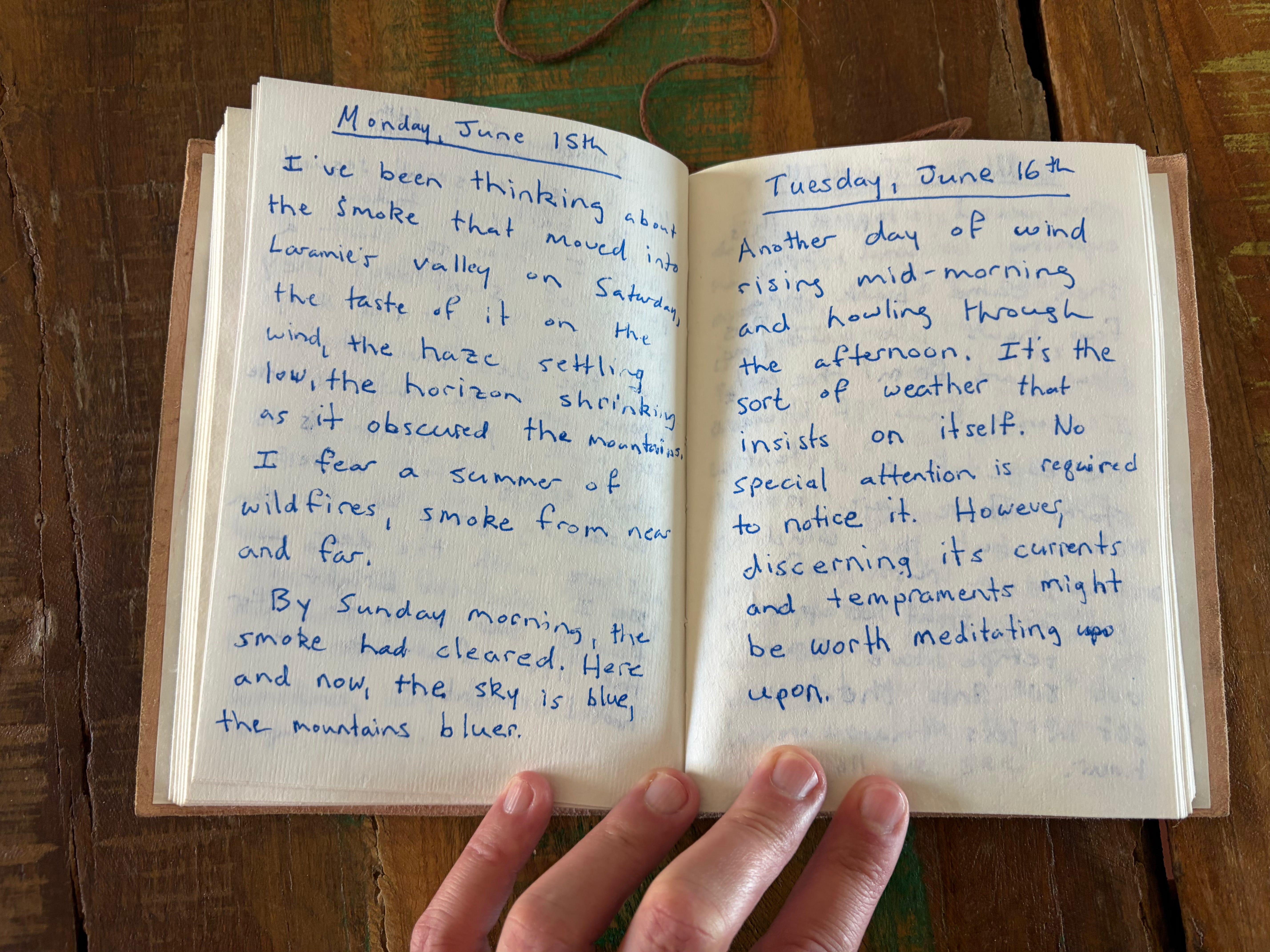
Monday, June 15th Entry: I’ve been thinking about the smoke that moved into Laramie’s valley on Saturday, the taste of it on the wind, the haze settling low, the horizon shrinking as it obscured the mountains. I fear a summer of wildfires, smoke from near and far. By Sunday morning, the smoke had cleared. Here and now, the sky is blue, the mountains bluer.
Tuesday, June 16th Entry: Another day of wind rising mid-morning and howling through the afternoon. It’s the sort of weather that insists on itself. No special attention is required to notice it. However, discerning its currents and temperaments might be worth meditating upon.
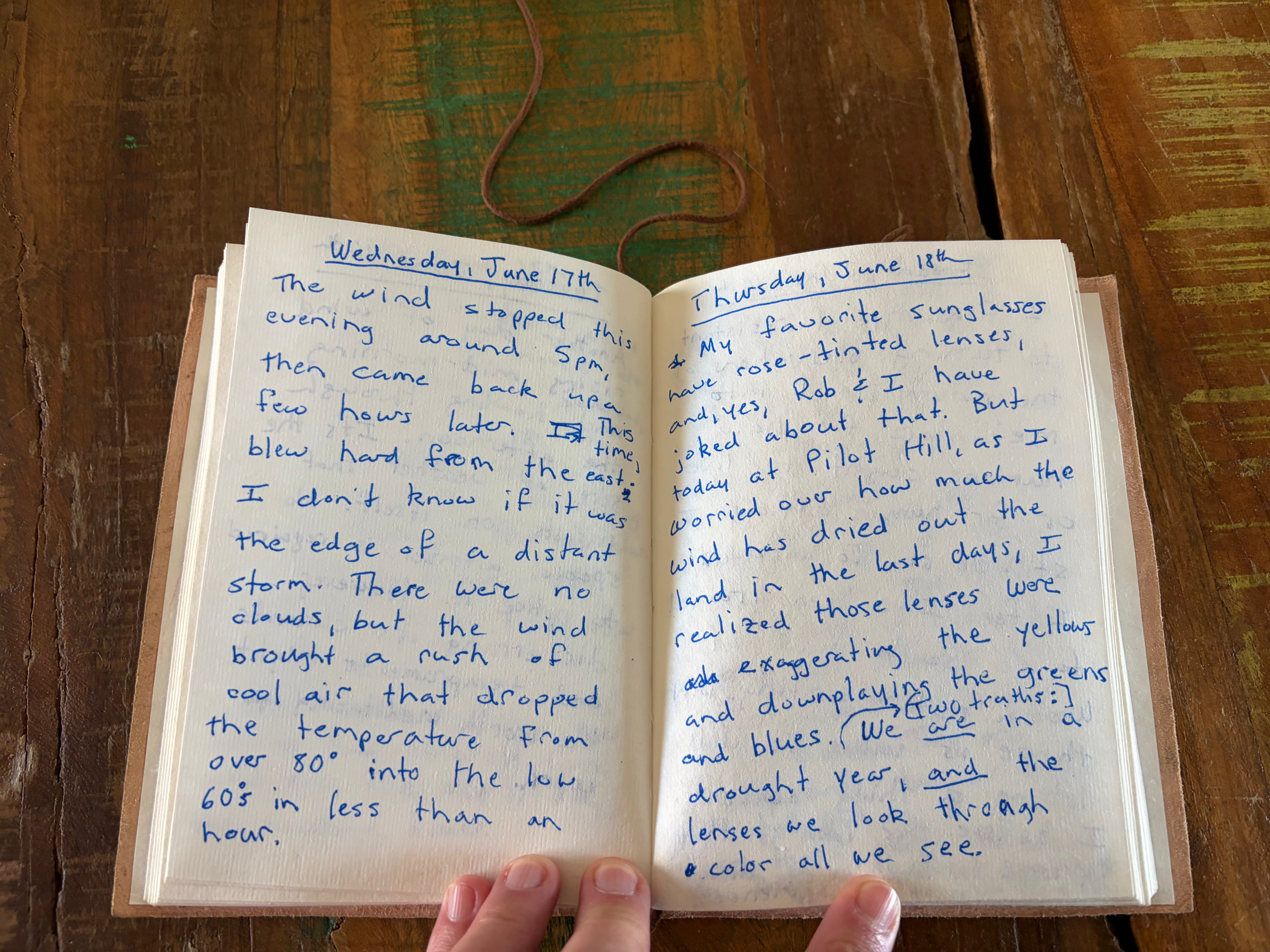
Wednesday, June 17th Entry: The wind stopped this evening around 5pm, then came back up a few hours later. This time, it blew hard from the east. I don’t know if it was the edge of a distant storm. There were no clouds, but the wind brought a rush of cool air that dropped the temperature from over 80 degrees into the low 60s in less than an hour.
Thursday, June 18th Entry: My favorite sunglasses have rose-tinted lenses, and, yes, Rob and I have joked about that. But today at Pilot Hill as I worried over how much the wind has dried out the land in the last days, I realized the lenses were exaggerating the yellow and downplaying the greens and blues. Two truths: We are in a drought year, and the lenses we look through color all we see.


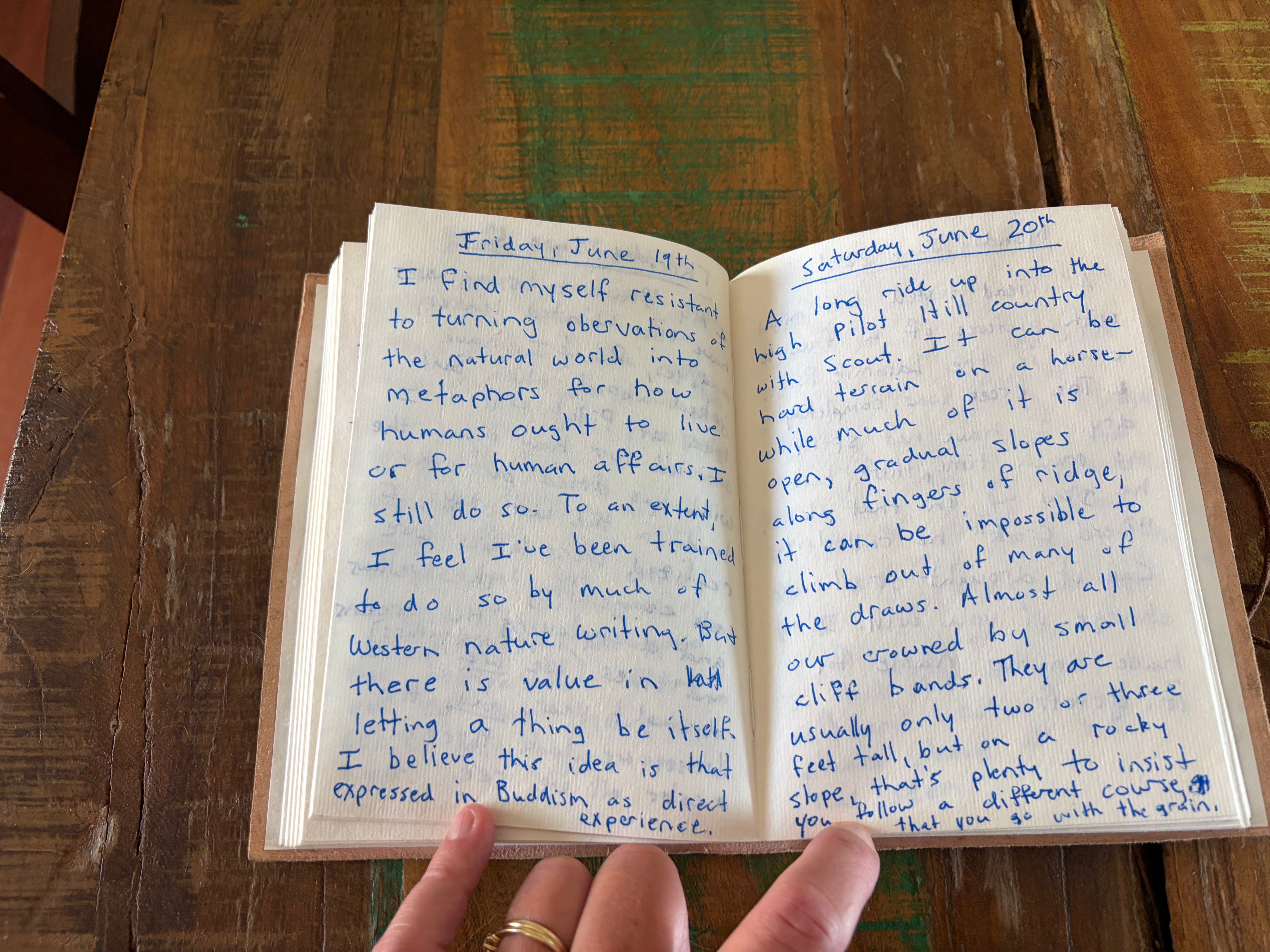
Friday, June 19th Entry: I find myself resistant to turning observations of the natural world into metaphors for how humans ought to live or for human affairs. I still do so. To an extent, I’ve been trained to do so by much of Western nature writing. But there is value in letting a thing be itself. I believe this idea is that expressed in Buddhism as “direct experience.”
Saturday, June 20th Entry: A long ride up into the high Pilot Hill country with Scout. It can be hard terrain on a horse—while much of it is open, gradual slopes along fingers of ridge, it can be impossible to climb out of many of the draws. Almost all are crowned by small cliff bands. They are usually only two or three feet tall, but on a rocky slope, that’s plenty to insist you follow a different course, that you go with the grain.
What I’m Reading, Writing, Watching, Listening To, and Thinking About This Week
I’m still thinking about Robin Wall Kimmerer’s Braiding Sweetgrass. I once received feedback from the editor of a literary magazine saying they would publish my essay if I made some “minor” changes. Among these was a fairly dismissive comment about my use of “he” to describe a buck antelope. “The correct pronoun for an animal is ‘it’,” they said. My choice to pull the essay wasn’t due to that comment alone—the scope of all the changes would have made the entire piece not my own. But that comment, the reduction of an antelope to an object, is the one that stuck with me.
In Wall Kimmerer’s essay “Learning the Grammar of Animacy,” she reflects on how the language we use shapes how we see the world. By sharing her efforts to learn Potawatomi and contemplating how the language gives personhood to all beings, she also asks us to think about how we can bring the spirit of that language into our own lives regardless of which tongue we speak. For example, she tells a story about a field biologist who spends most of her days with animals and other other-than-human beings: “Most of her companions are not two-legged, and so her language has shifted to accommodate her relationships. She kneels along the trail to inspect a set of moose tracks, saying, ‘Someone’s already been this way this morning.’ ‘Someone is in my hat,’ she says, shaking out a deerfly. Someone, not something” (Kimmerer p. 57).
When I first read this passage, I thought immediately of my own long-ago essay and finally understood why I’ve ruminated on that editorial feedback. It wasn’t about line-edits to “simple” word choice. It was a conversation that pointed to a deep divide in ways of seeing the world. For my part, I still prefer the approach Wall Kimmerer suggests. It feels more immediate, more connected, more playful, gentler, kinder.
Citation: Kimmerer, Robin Wall. Braiding Sweetgrass: Braiding Sweetgrass: Indigenous Wisdom, Scientific Knowledge and the Teachings of Plants. Milkweed Editions, 2013.
You can hear Robin Wall Kimmerer discuss these ideas in this interview with Orion.